2018年4月4日 星期三

Today’s Shooting Showed How Bad Twitter’s Misinformation Problem Is


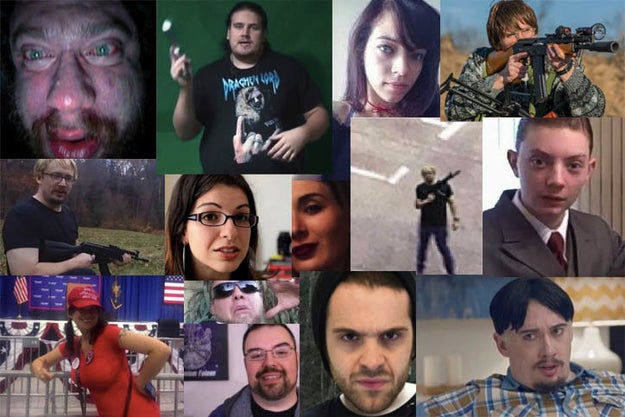
A sampling of individuals (incorrectly) accused on Twitter of being the YouTube shooter.

BuzzFeed News

Seconds after the first shots were fired at YouTube’s headquarters on Tuesday afternoon, a product manager at the company broke the news of the shooting with a tweet. “Active shooter at YouTube HQ. Heard shots and saw people running while at my desk. Now barricaded inside a room with coworkers.”

Within minutes, major and local news outlets were monitoring the situation. Then, almost immediately, came the garbage. There were: 4chan hoaxers trying, once again, to trick people into thinking the shooter was a comedian named Sam Hyde; speculation the shooter was motivated by YouTube censoring political content; speculation it was religiously motivated; photos of supposed shooters in MAGA hats; unconfirmed images of potential victims and inaccurate death tolls; and numerous conflicting reports that the shooter was female, then male, then female, again.

Twitter has long been a vital service for following along with current events as they unfold in real-time, and a place where news is both reported and made. But in the immediate aftermath of a tragedy, Twitter’s usefulness is offset considerably by a growing chorus of trolls, hoaxers, and irresponsible commentators. It’s loud and reactive at a time when restraint is most necessary. In the chaos of an unfolding tragedy, it is no longer a helpful place to follow breaking news.

This isn’t a new problem — fake Hurricane Sandy images of destruction and sharks swimming on the floor of a flooded New York Stock exchange went viral and were subsequently debunked on Twitter way back in 2012. But it’s one that’s seems to be getting worse. With every fresh tragedy comes a new, more sinister evolution of previous misinformation tactics.

During the Parkland shooting, BuzzFeed News identified five different people that were falsely passed off as the suspect. Today, there were 25 individuals, including many incarnations of the infamous Sam Hyde hoax. Like with Parkland, two reporters were targets of harassment — Vice political writer Eve Peyser, and one of the authors of this post, who was debunking the hoaxes.

When a reporter covering Parkland was targeted, Twitter CEO Jack Dorsey said the company’s policies should be re-examined. Today he said the misinformation was being tracked and action was being taken — but it kept spreading. The shooting survivor who first broke the news had his account hacked to post juvenile, homophobic messages, and hoaxes kept rolling in. Twitter took down the offending tweets after Dorsey got involved but its policy remained the same.

Mass tragedies of this variety have become a common enough occurrence that the online chaos is almost orderly; not only does the internet’s underbelly react to these events with alarming speed, but all sides seem to know their specific roles. There’s the channers attempting to spread misinformation for the lulz, the hyperpartisans looking to use the event to confirm past political arguments, the unconfirmed reports from citizen journalists looking for retweets, and the irresponsible journalists and news outlets breathlessly tweeting updates from notoriously unreliable police scanners. All of it serves to drown out the work of those who’re carefully reporting from on the ground, vetting, and knocking down reports.

Journalists have always been endeared to Twitter in part because it mimics the process and chaos of reporting, forcing one to navigate a deluge of source material, vetted reporting, commentary, and bullshit. For those reasons, Twitter also does a great job of laying bare the newsgathering process, which can be exhilarating and attractive to bystanders. But good tragedy reporting is also difficult, deliberate, and judicious, which is to say, wildly out of sync with the incentive structures — frictionlessness, virality, scale, and anonymity — that govern Twitter and help fake news travel faster than vetted facts.

In the last two years, Twitter has organized around live events. In 2016, CEO Jack Dorsey mentioned the live focus in almost every interview and earnings call, and fully embraced its crucial role in the journalism ecosystem by re-classifying itself as a News app in Apple’s store. The strategy makes perfect sense. Online, Twitter has no rival for real-time news. It is the best place to collectively take in a sporting event or award show or to endlessly discuss a Trump scoop.

But for an unfolding breaking news event with lives at stake, it’s hard to see the value of being glued to Twitter. One argument suggests that there’s merit in watching real-time debunks, as it helps build up one’s media literacy. That may be true, but it feels like it comes at an awfully high cost. Behind each debunk is a defamatory image and false allegation, not to mention the time spent by a reporter tasked with batting down what often amount to sinister pranks.

One of the hardest parts of a tragedy as an onlooker is the feeling of powerlessness that accompanies watching the event unfold. Twitter allows a way in and crucially provides a feeling of agency. But too often, it’s a false one.


via BuzzFeed - Tech https://ift.tt/2q482uP

2018年4月3日 星期二

This Country Said It Would Punish Journalists For Writing Fake News But Changed Its Mind


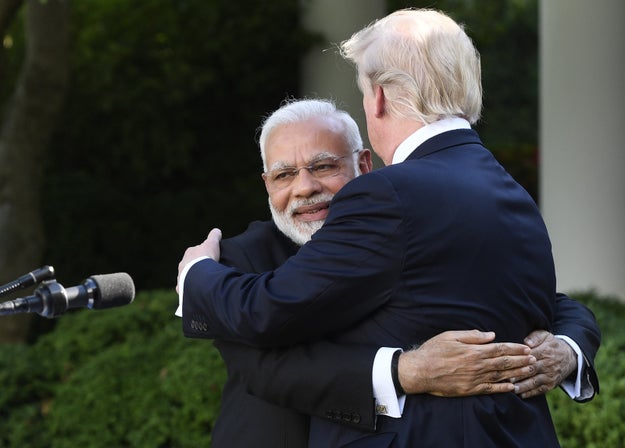
Indian Prime Minister Narendra Modi hugs US president Donald Trump in the Rose Garden of the White House last June. Trump popularized using the term "fake news" to describe unfavorable media coverage since taking office.

Afp Contributor / AFP / Getty Images

The Indian government announced it would crack down on so-called fake news by threatening to withdraw journalists’ official accreditation, but it withdrew the plan just a few hours later following complaints online.

The move was seen as an astonishing attack upon press freedom in a country where journalists are increasingly under siege — four journalists have been assaulted by police in March alone. The term fake news has come to be used to describe any stories the government doesn’t like, and critics said steps to combat it were actually a way to gag journalists ahead of the 2019 general election.

India’s Information and Broadcasting Ministry unveiled the anti–fake news measures on Monday, but they were withdrawn by Prime Minister Narendra Modi’s office by noon on Tuesday. In the past few months, governments in both Singapore and Malaysia have proposed similar measures to crack down on fake news while limiting the freedom of the press. In Singapore, Human Rights Watch has criticized the parliamentary committee formed to deal with fake news, stating that the committee was simply a way for the government to silence its critics. Meanwhile in Malaysia, the government has passed a law despite opposition to make fake news punishable by a six-year prison sentence.

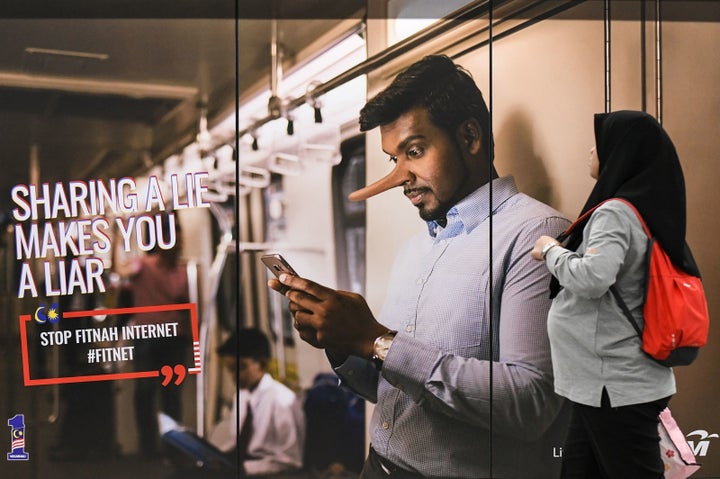
An anti–fake news poster in Malaysia.

Mohd Rasfan / AFP / Getty Images

Under the measures proposed by the Indian government, anyone would be able to file a complaint against a journalist or organization suspected of spreading fake news. A complaint would mean that the journalist or organization could be suspended from publishing anything while under investigation for a period of 15 days. If found guilty, the journalist or organization would lose their accreditation for a period of six months for their first offense, one year at the second instance, and permanently lose their accreditation if they struck out a third time.

The Editors Guild of India said it remained deeply disturbed by the plans, even after they were dropped. In a statement, the Guild said that the decision on what was “fake news” and what wasn’t could not be left to governments since the government was often charged with spreading fake news itself. Rather than targeting mainstream news organizations, it was less traditional media platforms, which operate with fewer constraints, that had the potential to cause far more damage.

As a report in the Indian Express on April 3 pointed out, Information and Broadcasting Minister Smriti Irani, has been tweeting links to stories she described as “fake news” that were in fact stories backed by police complaints, evidence, and paper trails. The report indicated that rather than taking the issue of fake news — i.e. the deliberate spread of false information — seriously, the Indian government was delegitimizing thoroughly reported and backed-up stories that showed the government in a poor light, all under the guise of combating “fake news.”

“The release makes no mention of the unregulated reach of Facebook, WhatsApp, Google, and YouTube, which are what need to be tackled right now,” said Geeta Seshu, a consulting editor with the Hoot, a media watchdog organization. What worried Seshu the most, she added, was that the government was ignoring “real news” under the pretext of combating fake news.

Last week for instance, Mahesh Vikram Hegde, the cofounder of a right-wing fake news website called Postcard News who is followed on Twitter by Modi, was arrested for “spreading communal disharmony” through a fake news story. Hegde had claimed through Postcard News and his social media that a Muslim man had attacked a Jain monk from Kerala, adding that “no one was safe” from communal violence in Congress-ruled Karnataka, not even Jain monks — who belong to one of the most nonviolent sects on earth. In fact, police reports later proved that the monk had been hit by a bike while walking on the road.

“The crisis of fake news in India has little to do with accredited journalists from mainstream organizations,” Seshu said.

Platforms like WhatsApp, which has more than 200 million users in the country, have enabled rumors, hoaxes, and misinformation to spread more rapidly than ever before. India is expected to hit 450 million internet users by June 2018 according to the Internet and Mobile Association of India, a telecoms industry lobby. Over half of the country’s internet-connected population uses Facebook messenger, which is difficult to police due to its end-to-end encryption.

The growing use of social media and the fact that India — the world’s largest democracy — is gearing up for major national elections in 2019 and several key state elections in 2018 has also caused to country’s media environment to become increasingly polarized. This has in turn led to the rise of independent, grassroots fact-checking organizations like Boom Live, Social Media Hoax Slayer, AltNews, and Check4Spam, a WhatsApp-based hoax busting hotline, over the last few years.

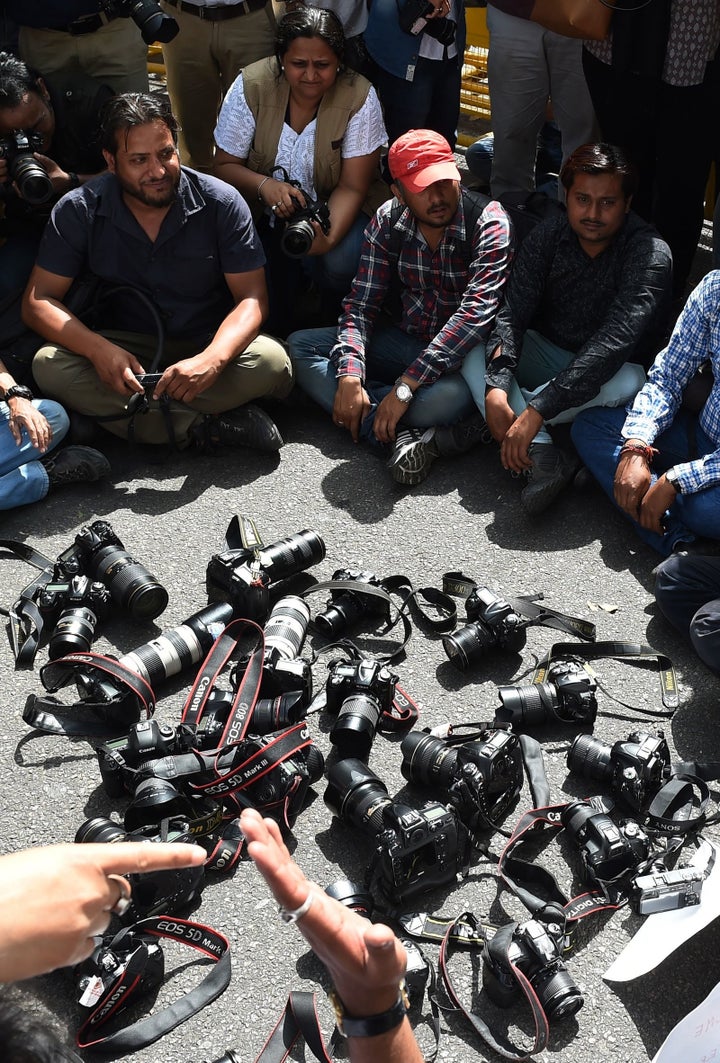
Indian journalists stage a protest next to the Indian Parliament over the alleged assault upon two reporters in March.

Money Sharma / AFP / Getty Images

The Indian press meanwhile is under siege. According to a report in 2017 by Reporters Without Borders, India fell from 133 to 136 on the World Press Freedom Index of 180 countries. Another report by the same organization took note of the recent surge in police violence against reporters in 2018 — there have been four separate instances of journalists being assaulted and detained in March alone.

On March 8, a photojournalist in New Delhi was beaten and detained by police officers while covering a local traders protest. Two days later, seven journalists were "lathi-charged," or beaten by police batons while covering a student demonstration, in the northeastern state of Assam. On March 23 a reporter was molested and assaulted by officers of the Delhi police while covering a student protest in the city, and on March 25 a reporter from the southwestern state of Kerala was beaten by the police and locked in a cell while on assignment.

Several Indian journalists said that Modi ordered the press release to be withdrawn because of the outrage with which it had been greeted, but this seems unlikely. In the past Modi's government has been unresponsive in the face of far greater outrage, ignoring nationwide sit-ins, angry editorials, and blank front pages in newspapers protesting the murder of journalist Gauri Lankesh.

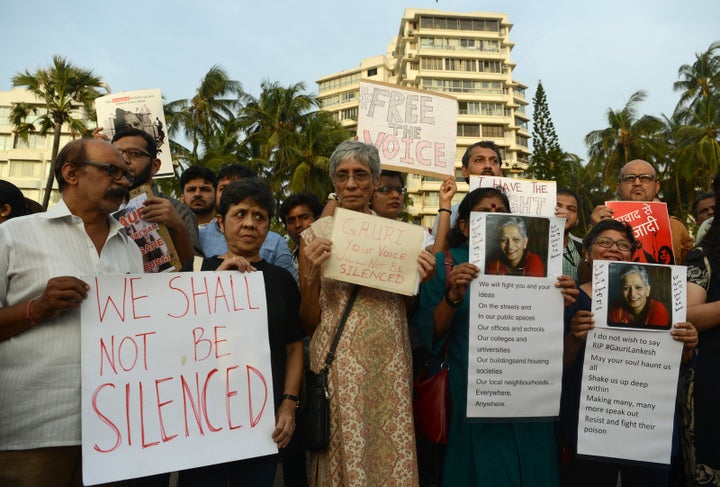
Indian protesters condemn the killing of journalist Gauri Lankesh.

Punit Paranjpe / AFP / Getty Images

The issue of press accreditation is a tricky one in India. Accreditation was important for a generation of journalists that relied solely on access to government officials, political parties, and traveling with the prime minister as part of the press entourage for news stories. However, as journalists in legacy news organizations as well as a multitude of news websites rely increasingly on official and unofficial leaks and sources that are online as much as within government offices, the need for such accreditation is arguably less important.

Government-approved accreditation also opens journalists up to further governmental scrutiny. In its eight-page accreditation form, the Press Information Bureau asks journalists to include details of their marital status, which gender they identify as, all the places they have lived for the past five years, how much they earn, the number of page views their websites get (in the case of online news organizations), and the amount of revenue the website generates annually. Freelance journalists are required to have at least 15 years of experience to qualify.


via BuzzFeed - Tech https://ift.tt/2JgsfGK

Grindr dating app slammed for sharing users' HIV statuses with other companies


Gay dating app Grindr is coming under fire for sharing users’ HIV statuses with two app optimization companies.

via FOX News https://ift.tt/2EdBGCZ

Instagram clamps down on apps amid Facebook data scandal


Instagram is cracking down on third-party apps by restricting their access to user data amid the fallout following revelations that Cambridge Analytica inappropriately gained access to the Facebook data of 50 million users.

via FOX News https://ift.tt/2uM2rPv

Mark Zuckerberg slams Apple CEO's 'extremely glib' critique


Facebook CEO mark Zuckerberg called Apple CEO “extremely glib” Monday morning for comments he made criticizing the social media giant’s ad-based revenue model and the company’s mishandling of users’ data.

via FOX News https://ift.tt/2q2TImn

NASA’s next planet hunter is ready to find undiscovered worlds


Scheduled for launch this month, NASA's Transiting Exoplanet Survey Satellite (TESS) will embark on a two-year mission to seek out new exoplanets close to Earth and, possibly, even evidence of extraterrestrial life.

via FOX News https://ift.tt/2EfzMBN