LOS ANGELES — For an event billed as an "E3 Extravaganza," Upload's mid-June celebration of the annual gaming conference was oddly subdued. Perhaps it was the headset-adorned partygoers, aloof in their immersive first-person shooters. Or maybe it was the chill of the bombshell sexual harassment lawsuit that had been brought against the virtual reality company just four weeks earlier.
While the tech world has been rocked with a spate of sexual harassment allegations recently, the lawsuit against Upload stands out. In the suit, filed in May, Elizabeth Scott, a former social media manager, alleges that prostitutes and strippers were invited to company parties,"male employees stated how they were sexually aroused by female employees and how it was hard to concentrate and be productive when all they could think about was having sex with them," and women in the office were referred to as "mommies" who were there to "help the men with whatever they needed." (Scott's attorney did not return multiple phone calls seeking comment; a spokesperson for Upload declined to comment.)

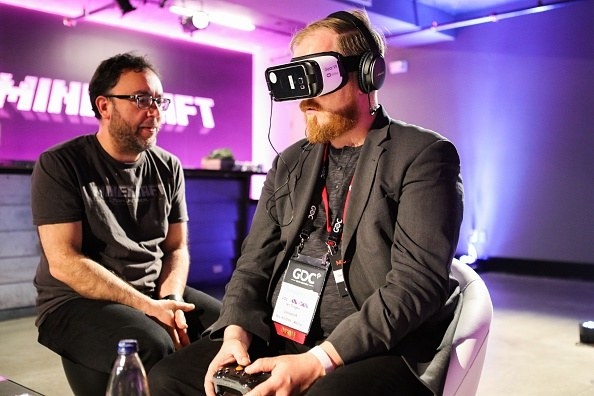
Ian Tingen of UploadVR uses Oculus goggles at The Village event space in San Francisco on March 15, 2016.
Gabrielle Lurie / AFP / Getty Images
Upload, which also offers a range of classes on various VR topics and publishes a news site about the industry, is not the only player in the VR space that's been hit with scandal in the last year. In February, VR company Magic Leap was sued for sex discrimination and retaliation by its former vice president of strategic marketing and brand identity, who alleged that she was fired after repeatedly trying to correct the company's gender imbalance and general hostility toward women. The suit quotes an IT support lead allegedly saying, "we have a saying; stay away from the Three Os: Orientals, Old People and Ovaries." In March, Oculus founder Palmer Luckey left Facebook (which bought Oculus in 2014 for $2 billion), six months after he had donated $10,000 to a pro-Trump organization and meme group called Nimble America affiliated with Milo Yiannopoulos, and for secretly donating $100,000 to Trump's inauguration in the name of a company called Wings of Time. And in May, Oculus's head of computer vision, Dov Katz, was arrested for soliciting sex from an undercover police officer he thought was a 15-year-old girl.
"I love VR for its potential, but these fucking man-babies are ruining it."
With its umbilical cord still firmly attached to the gaming world from which it emerged, VR seems in some ways tethered to that industry's long history of sexism. Can a world in which young men are given millions of dollars with little accountability ever really be a space where women can thrive? According to over a dozen women (and a couple of men) interviewed by BuzzFeed News who are involved in virtual reality, the answer is complicated.
"This is the third time that a big VR company or person has been the scum of the earth," said a VR producer who asked to remain anonymous, referring to the most recent scandal at Upload. "I love VR for its potential, but these fucking man-babies are ruining it."

Gaming fans in VR goggles play "Echo Arena" from Oculus on June 14, day two of E3 2017, the three-day Electronic Entertainment Expo at the Los Angeles Convention Center.
Frederic J. Brown / AFP / Getty Images
In 2016, the VR and AR (augmented reality) sectors attracted $2.2 billion in investment, a 300% increase over the $700 million invested in 2015. (Upload, for its part, closed a $4.5 million Series A round of funding in September.) The field has been heralded as the next big thing in tech for the past four years or so — and has also been lauded as a kind of utopia for female developers and producers in VR, something of a blank slate in a broader industry not known for being kind to women. A New York Magazine article last September proclaimed, "In Virtual Reality, Women Run the World," arguing that because the field is so new, "female creators have gotten a rare opportunity to start from a level playing field."
But if the past year is any indication, VR might not be quite the do-over optimists had hoped for. After all, this is an industry that emerged out of three notoriously misogynistic and male-dominated industries: video games, Silicon Valley, and Hollywood.
"These industries have not been very friendly to women," said Angela Haddad, a virtual reality creative director in LA. "They haven't been very inviting or supportive in general. Silicon Valley and the entertainment industry are both bro cultures. There's been a lot of concern that VR will end up like these two industries."
If the past year is any indication, VR might not be quite the do-over optimists had hoped for.
Or as Taryn Southern, a YouTube personality who is now working in VR, put it: "We don't want to end up with Silicon Valley tech bro culture shaking hands with Hollywood sleazy producer/director culture."
In some ways, they already have. Much like in Hollywood, female directors are rare, according to Molly Swenson, cofounder of RYOT studios. And much like in video gaming, where the use of “booth babes” is still relatively common despite the backlash against it, it's almost exclusively women who are hired as "concierges" at conferences and conventions, encouraging people to come try on VR headsets.
Kent Bye, who hosts the Voices of VR podcast and writes about the industry for the Road to VR site, recalled attending an Upload party where guests were checked in by models. "What message is that telling me and other women in the industry, hiring models to play that role?" Bye said. "One of the claims Elizabeth [Scott] is making is that she could never check people in because she wasn't attractive enough. That seems incredibly plausible." (The lawsuit states that "[Mason] also made it known that he did not find Plaintiff attractive and that she could not be used for marketing purposes because she was 'too big.'")
Upload's former event producer, Olya Ishchukova, is also the founder of a company called Models in Tech that supplies models to tech companies for parties and conferences; for the year she was a contractor at Upload, from December 2015 to December 2016, she was simultaneously running Models in Tech. (An Upload spokesperson told BuzzFeed News that Ischchukova "worked on Upload events but also ran her business on the side. Models in Tech was never 'based' out of Upload SF." Ishchukova did not return a phone call seeking comment.)
"Models were everywhere," said someone who works in VR in the Bay Area who asked to remain anonymous. "At all of their events, models were greeting, models were hosting." (Upload cofounder Taylor Freeman is on the Models in Tech website giving an endorsement: "Always knowledgeable, always professional. Models In Tech run vr demos at our events, engage with attendees and educated them about new virtual reality experiences.")
Instagram: @modelsintech
Virtual reality is a notoriously small community — so small, in fact, that as Jodi Schiller, the founder of a VR company called New Reality Arts, noted, “it really feels a lot of times like I'm in high school again.” In Upload’s case, that means the organization is everywhere; they know everyone, and everyone knows them. But Upload, Schiller said, “were the popular kids. They were a driving force, they were the nucleus. Everyone has a connection from Upload." And so for many in the VR world, it was especially disappointing when Upload, viewed as a pillar of the nascent community, was accused of sexual harassment.
Upload's role in the community made it particularly hard to speak out — especially since, at least externally, the company’s management seemed outspoken on gender equality. Cofounder Will Mason, who is 27, was briefly on the advisory board of SH//FT ("Shaping Holistic Inclusion in Future Technologies"), an organization founded by Jenn Duong and Julie Young, two LA-based young women in VR. He also contributed to discussions in the Women in VR Facebook group, which Duong and Young co-founded in the fall of 2015, and which boasts that its membership of 5,600 comprises of 80% women and 20% men. According to screenshots provided to BuzzFeed News, as recently as April, Mason had posted in the group that "the women in this group contribute a lot to making this industry the best in the world. I'm so glad that we are focusing on building VR and AR with a diversity focused approach :)"
"On paper [Upload was] doing so much good for VR as an ecosystem," said the anonymous VR producer. "They were trying to create a virtuous cycle for VR …. Unfortunately, they're fucking scumbags, I guess."
"They were trying to create a virtuous cycle for VR …. Unfortunately, they're fucking scumbags, I guess."
Several women interviewed by BuzzFeed News expressed discomfort with how the group had handled the allegations. Some argued that the group's admins were too slow to act. Others said they questioned some messages Duong, in particular, posted to the group defending Upload. A comment in which Duong said she "viewed Upload as family to be very honest" and wanted "nothing more than for them to succeed" was particularly troubling to members who worried Upload was using them to polish its image. As one group member wrote, Upload had positioned itself as "a young, hip, progressive company that was about building community" and that they had "used people — Jenn Duong and others — to bolster the perception that they were a feminist-supporting, diversity-supporting organization that was positive for women."
By mid-June, Mason and Freeman, along with two Upload employees named in the suit — Avi Horowitz and Greg Gopman (who is no longer working for Upload) — had been removed from the group.
"After receiving several member complaints that the presence of Upload executives within the group violated the sanctity of the space, we voted to remove said executives from the group," Young and Duong told BuzzFeed News via email when asked in mid-June how they were addressing the fact that some members of Women in VR felt uncomfortable airing some of their issues with Upload in light of Duong's friendship with Will Mason and his previous position on the SH//FT board. "We've also taken the conversations that happened around the Upload situation as an opportunity to revamp our community standards and guidelines to make sure that they reflect the needs of the community."

Adriana Ojeda uses an Oculus headset at Facebook's F8 Developer Conference on April 18 in San Jose, California.
Justin Sullivan / Getty Images
Upload is, to be sure, an extreme example. But even women who said they view the VR industry as a generally welcoming space said they'd had negative experiences. Ainsley Sutherland, a VR game designer who is a former BuzzFeed Open Lab fellow, recalled being unwittingly photographed during an Oculus demo. "There's something really odd about it — this idea that this woman can't see that we're all looking at her," she said. "It's a little creepy. Especially because it's way more dudes than girls."
Adaora Udoji, who started a VR and AR company called ZFs4 Productions after a long career in radio and broadcast news, remembered moderating an all-female panel about VR where two men interrupted the panelists before the Q&A started: "I've never been in a place where someone in a room of 150 people injected himself into the conversation,” she told BuzzFeed News about one of the men's comments. “And what he was saying was very hostile, that women don't have the skills. And you're talking to a panel of women who are technologists. It was so out of the bounds of accepted public behavior in a professional setting."
Southern moderated a Women in VR panel about pornography at a conference that got derailed by a male audience member. "We were having a discussion around porn and VR and how the industry needs to be thinking and talking about porn and how it's shaping the industry," she said. "We were being cognizant and thoughtful about it. This male individual berated us … saying as 'females' you have a responsibility to protect our children. It was very intense. It was an interesting display of this idea that somehow as a woman in VR, we can't talk about the same material or subject matter, that we have a responsibility that males don't have."
Haddad was one of two women at a recent conference in the Bay Area. "Almost every man I spoke to assumed I wasn't in the VR industry, that I was accompanying someone at the conference. They kept asking, 'Who are you here with?' That's definitely stuff that sticks with you."
"This is an industry that is forming as we speak. And we have a huge opportunity as this industry is in its nascent stages — we have an enormous opportunity to do better."
Certainly, some people are trying to change the industry. Discussions on Women in VR often raise issues around gender parity at conferences. Shiller runs a Women in VR Meetup in the Bay Area with nearly 1,500 members, as well as another Facebook group, and women regularly attend VR meetups in New York and LA. Women in XR is an organization started by Malia Probst and Martina Welkhoff that aims to connect women in VR and AR with venture capital. The Reality Experiment is a series of monthly dinners with women in the VR and AR space hosted by Dani Van de Sande, who now works at Snap after running her own VR consultancy. And female industry stalwarts like Nonny de la Peña have certainly made their mark. Udoji said she still sees "a bunch of entry points for women in VR that just don't exist in the same way in the more mature industries."
"This is an industry that is forming as we speak. And we have a huge opportunity as this industry is in its nascent stages — we have an enormous opportunity to do better," Probst said. Or as Schiller put it, talking about what happened at Upload: "What I wish had happened is senior management/leadership had said to these young guys, ‘Hey, dudes, this isn't cool. Stop.’ Or given them better guidance." Of course, guidance can be hard to come by: BuzzFeed News contacted all of Upload's investors to comment on the lawsuit, but only one — Presence Capital — responded: "We don’t comment on ongoing litigation with our portfolio companies and suggest you reach out to Upload for any details. But we’re following it closely."
For women in the field, investors' nonresponses aren't enough. As RYOT cofounder Swenson said: "It’s always representative to me of this much larger issue of people in power not deploying resources against fixing the problem. Anyone who controls money and resources — it’s their responsibility to be part of the solution.” ●
via BuzzFeed - Tech http://ift.tt/2tJA9TZ